


Filters and Categories
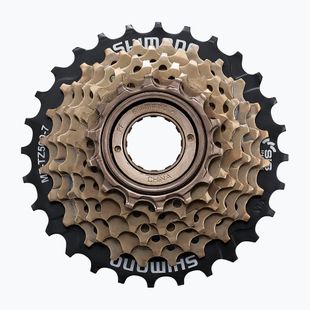
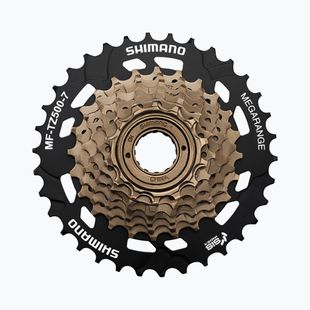




Bicycle freewheelers on offer at the Sportano shopRiding a bicycle has brought joy for many years and is a great means of transport for many people around the world. A key part of the drive mechanism of any bicycle is the freewheel. It is responsible for the ability to drive forward, while allowing the pedals to spin freely backwards without affecting wheel movement.Construction and mechanism of the freewheelThe freewheel is a compact mechanism that plays a key role in the propulsion of most traditional bicycles. It is a purpose-built device that allows the wheel to rotate forwards without moving the pedals, while blocking the wheel from rotating backwards.
At the heart of the freewheel is a gearing mechanism, consisting of a series of cogs and so-called "pawls" - small claw-like elements that lock the cogs when we try to pedal backwards. This ensures that when we stop pedalling, the wheel continues to turn and the bike moves forward. However, when we try to spin the pedals backwards, the pavilions interact with the sprockets, locking them and preventing the wheel from rotating in that direction.
In addition to the main gear mechanism, the freewheel has bearings that allow the mechanism to rotate smoothly around the hub axis. These bearings are usually lubricated with a special grease that reduces friction and wear, extending the life of the entire unit.
The outer part of the freewheel, where the sprockets are attached, often has different sizes and number of teeth. These sprockets, combined with the bicycle chain, determine the gear ratios available to the cyclist, influencing how easy or difficult it is to pedal in different conditions.Freewheels versus cassettes: key differencesFreewheelers and cassettes are the two primary drive systems used on bicycles, but although they both perform similar functions, there are several important differences between them.
A freewheel is a unitary mechanism that integrates both the cogs and the freewheel mechanism into one part. It is directly bolted to the rear wheel hub. Due to its design, it can be difficult or even impossible to replace the individual sprockets in a freewheel. Freewheel sprockets are more commonly found on older models of bicycles or those at the lower end of the price spectrum.
A cassette, on the other hand, is a set of loosely stacked sprockets that are mounted on a special freewheel rear hub. The advantage of cassettes is that they can be easily disassembled and individual sprockets can be replaced as required. Thanks to this modularity, cassette drive systems are more popular on modern bicycles, especially those designed for more advanced use.Choosing the right freewheel: criteria and recommendationsWhen choosing a freewheel for your bike, there are several key factors to consider. First and foremost, it is important to match the number of sprockets of the freewheel with the number of gears in the shift handlebar.
Another important aspect is the gear range. If you plan to ride in hilly terrain or if your goal is to ride fast on flat terrain, you need a freewheel with the right gear range. The greater the sprocket range, the greater the variety of gear ratios, allowing you to ride up hills more easily and on the flat more efficiently.
The quality of the materials from which the freewheel is made also matters. Better quality freewheel gears, made from durable materials, will last longer and cope better with constant wear.
Ultimately, it is a good idea to consult an expert or bicycle mechanic before making your choice. Experts will be able to provide valuable information and recommendations on the best fit of a freewheel for your bike and riding style.
Collapse the description